

Featuring stories from Eric Shanower, Troy Riser, Michael Tierney, and seventeen other masters of the form, FANTASTIC VOYAGES is all about doors --
Musk vs. Derrickson: When Did Every Movie Release Become a Culture War?
FTC Statement: Reviewers are frequently provided by the publisher/production company with a copy of the material being reviewed.The opinions published are solely those of the respective reviewers and may not reflect the opinions of CriticalBlast.com or its management.
As an Amazon Associate, we earn from qualifying purchases. (This is a legal requirement, as apparently some sites advertise for Amazon for free. Yes, that's sarcasm.)
Submitted by Raven Oweiner on Thu, 07/23/2026 - 10:21
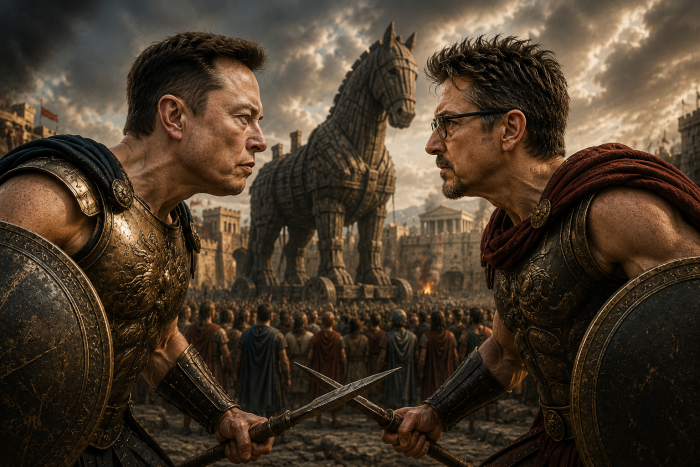
Christopher Nolan's The Odyssey should have been one of those rare movie events that unite film lovers. A director with a sterling reputation. A timeless story. A cast packed with recognizable stars. A filmmaker known for practical effects taking on one of literature's greatest adventures.
Instead, before most audiences had even bought a ticket, the conversation had already wandered somewhere else.
Elon Musk accused Nolan of sacrificing artistic integrity through his casting choices. Scott Derrickson answered by saying Musk "doesn't know shit about cinema."
At that point I realized something.
Hardly anyone was talking about Christopher Nolan's movie anymore.
They were talking about Elon Musk.
That's become the pattern. A casting announcement drops, someone famous objects, someone equally famous objects to the objection, and suddenly the movie itself has been pushed to page three. The debate isn't about cinema anymore. It's about the people having the debate.
We Don't Debate Movies Anymore
We've seen this movie before. Barbie. The Last Jedi. Disney's live-action The Little Mermaid. Snow White. Pick almost any major release from the past several years and you'll find the same pattern. Long before opening night, the argument stops being about the film.
Before anyone discusses the acting or the script, everyone wants answers to different questions. Is it woke? Is it anti-woke? Who's already calling for a boycott? Which YouTuber declared victory? What tribe are we supposed to join?
By opening weekend, millions of words have already been written by people who haven't seen the film.
Christopher Nolan's answer was refreshingly old-fashioned: watch it first, then judge it.
Musk Isn't the Story
Whether Elon Musk was right or wrong isn't actually the interesting question.
He's entitled to dislike Nolan's choices. You're entitled to think he's completely off base. Derrickson is entitled to think Musk doesn't understand cinema.
But notice how quickly every position stops talking about the movie.
Instead of discussing performances, adaptation, cinematography or storytelling, the conversation shifts to motives.
Everyone becomes an amateur psychologist.
Almost nobody becomes a film critic.
The Algorithms Love This
The internet doesn't reward nuance. It rewards escalation.
Hollywood isn't innocent. Every controversy creates another week of headlines. Every headline creates another round of social-media posts. Every post becomes free advertising.
The loudest version of every opinion is the one the algorithms choose to amplify.
And we reward the cycle every single time.
Here's the Irony
Outside social media, most people still ask the one question that actually matters:
"Was it good?"
Imagine that.
Maybe We've Forgotten What Movies Are For
Movies aren't elections. Buying a ticket isn't casting a ballot.
Sometimes people simply disagree about adaptations. Sometimes they disagree about performances. Sometimes they just don't like a movie.
Christopher Nolan's The Odyssey may ultimately be remembered as one of the year's best films—or one of its biggest disappointments. Time will sort that out.
Somewhere along the way, the movies stopped being the event.
The arguments became the event.
And that's one sequel I don't remember anyone asking Hollywood to make.


FEATURED ALBUM
Songs of faith, family and moving forward.
Latest Release


